Best of luck to the Uni High Inventor's Club in future endeavors.
They went to Boston and presented their design and have wrapped up the Inventor's Club Project for the time being.
I think it would be nice if the Independence Junior College students could post some of their pictures from the intern experience.
Shrimp ecocertification work will continue through 2010 and 2011.
Keep an eye on the Happy Anachronism for updates on work there!
Sunday, September 19, 2010

Thursday, May 13, 2010
Feeding trials continue

Trials are continuing here in Belize. We are making a direct comparison of early post larval shrimp growth (1,200 per tank @ 25/m2) and survival when fed on AquaMats that are colonized by normal growth vs. allowed to trap suspended sediment in the control structures. The picture above shows the AquaMats in the control structure (front) and being colonized in still water (rear). The mats in the control structure fill with algae in a few minutes. If the shrimp will eat that material and a low cost harvest technique can be found, they can remove a significant proportion of the algae leaving the pond (which is also a significant proportion of the nutrients leaving the pond). The Uni High prototype could be installed in a similar manner. We'll project findings from this experiment onto the Uni High findings to estimate yeild and potential viability of strained food sources as feed. AquaMats are already a known viable food source.
Wednesday, May 5, 2010
Feeding Trials!

The huge experimental tanks in this picture are being filled as I type this. By the end of the week, we'll be ready to begin feeding trials for shrimp post larvae.
NEED A PROTOTYPE DESIGN!
If logistics are prohibitive, we can just move ahead with Aquamats but it would be nice to get some information from the exact device the club is going to present in Boston.
Inar and I will be running the trials. The interns had a good experience learning water quality etc, but time has run out on their semester.
Hope everyone is having a great spring!
Send us what you can!
Friday, March 26, 2010
Testing Plan
We want to estimate the growth curve for the purpose of:
1. Having some hard data proving that our material actually promotes growth
2. Estimating the growth curve on our belt design to determine optimal frequency of harvesting
This test being done in Illinois as well as Belize is helpful because Illinois testing will serve as a template for Belize testing: we can modify test design based on what did or did not work, and have an estimate of what the curve will look like (i.e. how long the exponential phase of growh is in comparison to the stationary phase). It will also be interesting to compare how the apparatus will grow algae in different environments.

(Typical growth curve for Tetraselmis suecica.We expect a similarly shaped curve, but our scaling will be slightly different. Source:http://www.fao.org/docrep/007/y5720e/y5720e08.htm)
Some basics about the test:
Algae harvest will be done using a single nail brush, not a harvesting mechanism (why? 1. our belt design was ready before the harvester is ready, 2. we don't want to be able to attribute error to inconsistency in harvest. this is a growth test, not a system test)
The data we aim for is actually a graph [img]. We'll be plotting grams of dry mass per square centimeters of belt against elapsed time (since last harvest) . Collection will occur at two day intervals at roughly the same time (in the morning). We divide the belt up into ten sections from which we harvest at scheduled intervals (so that our data will be spread out evenly).
Testing time is continuous. Although we will have the minimum useful data set by April 16th, we plan to either continue testing or launch a new round of testing using the harvester we eventually plan to implement.
At each harvest time:
0. Weigh watch glasses
1. Collect from the sections appointed for the day using a nail brush. Collect entire wet mass in a watch glass. Record having harvested.
2. Situation 1: We are allowed to bring home electronic balance. We allow the wet mass to sun dry, and if that isn't possible, we bake the material. Either way, we end up with dry material, and measure the mass (subtracting the watch glass weight). Situation 2: We (carefully) bring the watch glasses into school, bake in the oven in the chem room, and measure dry mass (subtracting the watch glass weight).
3. Record on paper and excel. The excel document will create the graph.

Flaws:
This data is only useful for static water (as opposed to implementation near the control section with accelerated mass collection).
Imprecise. Continuous testing is impossible, human error unlikely but possible (inconsistent harvesting?)
Tuesday, March 23, 2010
Prototype testing in Illinois
Hello everyone! It looks like good progress is being made in Belize. I look forward to the results of the most recent installment.


Outdoor prototype testing has begun recently, and the weather has finally gotten warmer for good it seems. We took a pre-existing design and altered it to work in a creek. This is what it looks like.

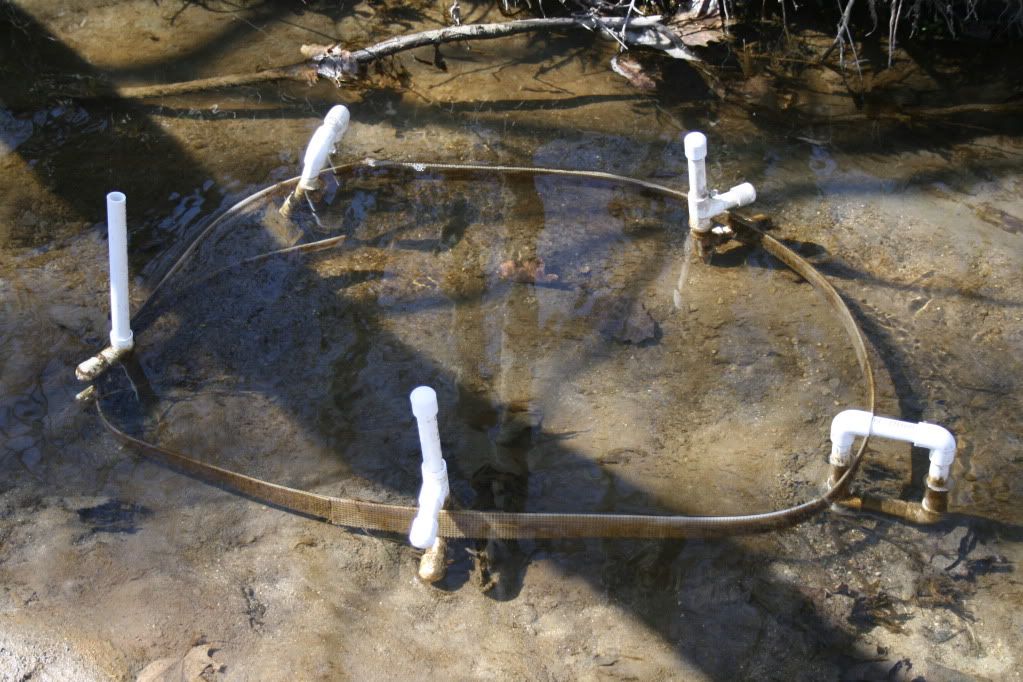
This design can be scaled to fit basically any size/shape pond. The belt is a double layered plastic embroidery sheet, with cheesecloth between the two sheets. The things that hold the belt in place, I'll call them belt guides, are PVC and come in two different forms. The first kind is a complete square, to enclose the belt. The second has two prongs to guide the belt. The second type is more efficient.
The belt has been in the water for about a week now, and this is what it looks like up close.
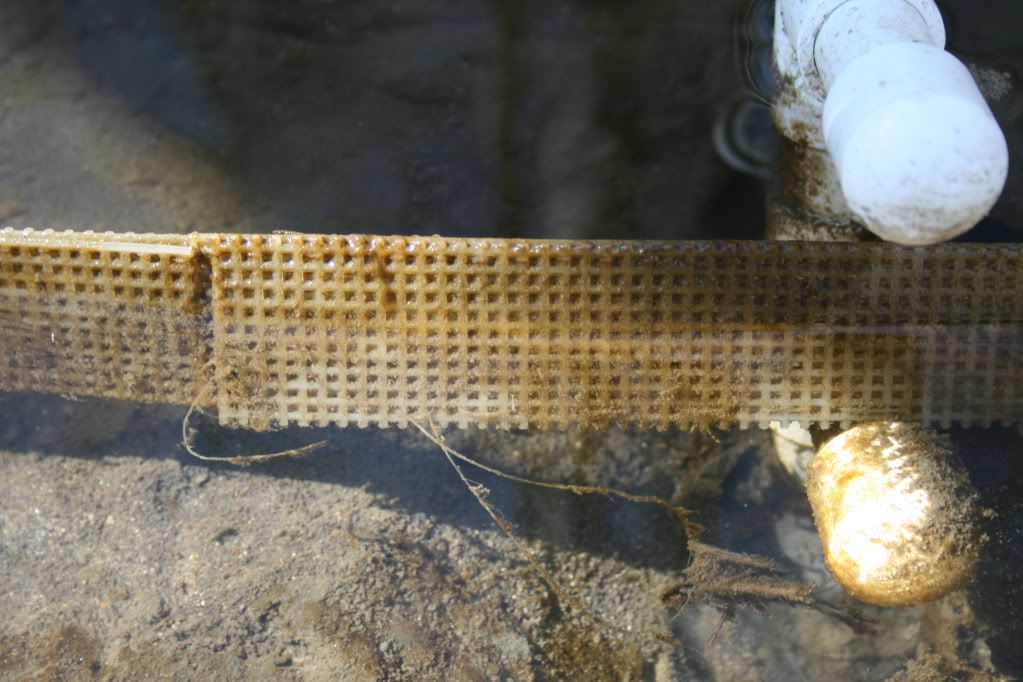
After March 16's post, Inventors Club is going try to incorporate these control structures, because it seems we could get a lot of yield from this. We would need some sort of efficient harvesting method. The harvester for this belt design is coming on 3/31. I'm not the expert on the harvester, so when it's implemented I'll post pictures and explanations. It uses rotating nail brushes to remove algae.
I look forward to hearing some feedback on this design!
Sunday, March 21, 2010
The Interns Hit the Ponds!
 Working under the direction of Inar Cayetano of Aquamar Shrimp Farm (on the left), Shamika Logan (middle) and Lisa Guttierez prepare and install AquaMats in a sedimentation pond to help trap additional nutrients and sediment.
 Results will be posted soon.
 Looking forward to meeting with the Uni High Inventor's Club soon to discuss progress!
Tuesday, March 16, 2010
Quick Lessons About Sedimentation Ponds

I'll try to make this brief and brilliant.
This is the control structure (dam) for a sedimentation pond. Shrimp farms use sedimentation ponds to trap water and let organic and inorganic particles "settle" to the bottom so they won't enter natural water ways. They are a good way to remove nutrients and they are where we plan to deploy the Inventor's Club invention to remove nutrients.
The control structure generally looks like some variation of the object above, with removable boards slid into slots in a concrete post holding back the water and creating the dam.
The water comes into the pond looking like this...

 ...and leaves the pond looking like this (much, much clearer).
And yesterday the water was that much clearer still, because we tried a little experiment with Aquamats. Inar Cayetano, the new environmental coordinator at Aquamar shrimp farm and myself, placed an Aquamat at the outflow of a control structure...and in SIXTEEN HOURS...on a completely clean Aquamat, we got THIS to grow....
 Ladies and gentlemen...that is some serious biomass yield.
 I'll try to post numbers soon.
While you are thinking about your designs, keep this little experiment in mind. This kind of yeild opens up some very efficient design possibilities.
Thursday, February 25, 2010
New Interns!

Yesterday, five new interns from Independence Junior College met to discuss the upcoming projects for their environmental internships working to learn about and improve water quality at shrimp farms in Belize.
Along with learning to test water quality and implement mitigation projects, they will be helping to test the Uni High Inventor's Club water quality apparatus. From left to right the group includes Natasha Bennett, Rennee Cadle, teacher and intern sponsor Abigail Parham, Shamika Logan and Lisa Guttierez. Also working with the project but not pictured here is Omar Sierra.
Thanks to Uni High, and the Lemelson Foundation for the use of the waterproof camera (held by teacher Abigail just over Renee's right shoulder). The interns will use that to document their progress and keep us all appraised of their successes.
All interns will begin work next week. We're prepped and ready to go!
Saturday, January 2, 2010
Progress!
Despite having neglected to post reports of our sucesses for a few months*, inventor’s club has been making plenty of advances. Our newfound funding from Lemilson-MIT was utilized to supply us with a grocery cart full of hardware store gems, from plastic sheets to squeegees to goldfish. Combined with the addition of three aquamats to our collection (thanks Belize!), we were finally ready to set up some more advanced tests.


We set up four fish tanks with filters, goldfish, and pondwater. The objectives of our experiments are to test the capacity of various materials for growth, to be able to compare different harvesting methods, and to have a tangible model of algal growth on substrates to spark creativity.
Meanwhile, members of our innovation/brainstorm group were exploring a few different concepts. We toyed with the idea of creating a quick method to apply silicon to substrates before emersion in the water to promote more growth. This was inspired by a closer reading of the aquamat manual, where it is recommended that the mats be soaked in chemicals for several hours before introduction into the shrimp ponds. Polluting the canals with excess silicate was one concern.
Another concept we discussed at length was the option of open water harvesting. From looking at any pond we know that diatom growth occurs without special substrates, and there are preexisting methods of controlling these (pond vacuums, skimmers, and enzymes for your neighborhood catchment). We looked into different ways to blow algae to the top (like a centrofuge effect). Another option would be a substrate that sort of functions as a net, growing algae near the bottom of the pond and then, when ready to harvest, catching the free water algae as it is pulled to the surface of the water.
Many design ideas were thrown around, written down. Other group members meanwhile played with the CAD modeling software. Their main success was to get a running model of a capped pipe with water flowing through it, which will be helpful when we want to put our virtual prototype in canal conditions. Those managing our finances handled receipts, and communicators/researchers contacted people from the geological survey.
After about two weeks of growth, we took the substrates out to see what we had grown. With the help of the school’s biology teacher, Mr. Stone, we used a microscope to observe the filamentous algae, and then discussed designs with him. Having grown lots of aquarium algae, Mr. Stone helped us bring together some components of previous designs for a new system that we are currently working to design, test, and improve. If we were to target one meeting as a “breakthrough”, it would be the one that Mr. Stone attended. More details on the latest design to come when I can get some photos of our model to help describe it.


As part of the grant requirements we are working on five videos about the project. As we’re producing storyboards and organizing filming, we realised that footage from Belize would aid our videos immensely. So, if anyone is in the mood to take a couple shots of canals, shrimp, ponds, people… Video team would be eternally grateful!
*Inventor’s club’s new years resolution: better communication.
Saturday, December 5, 2009


Tuesday, October 27, 2009
Continued Progress

We planted more mangroves at Royal Maya Shrimp Farm last Saturday and had quite a good time (despite the heat).
There were no crocs, but we did find some footprints.
I will be visiting Urbana in about a week and need to know how many Aquamats to bring and what type. I saw that almost 40% of the Uni student body is sick with H1N1 or other sicknesses (Yikes! Who knew coming to the US could be so risky?). In any case, I would fly into hades if necessary to see the state cross country finals, so I'll be there. Tell me a good date between the 6th and 12th if you want to meet.
Here's a quick update on the use of the site. We're well over 3,200 hits (not quite the 6,000 I mis-remembered during our Uni meeting last month). Unfortunately, I was also a bit lax keeping up with all the countries who monitored our site over the summer so these stats will be a bit under-represented. Looking back through September and October and the countries we had already logged, it appears we have at least 44 different nations checking in on us. Those include:
Abu Dhabi
Argentina
Australia
Belize
Brazil
Brunei
Canada
Cayman Islands
China
Columbia
Costa Rica
Croatia
Czechoslovakia
Dubai
Ecuador
England
France
Germany
Guatemala
Honduras
India
Indonesia
Italy
Jamaica
Laos
Malaysia
Netherlands
Pakistan
Philipenes
Poland
Portugal
Saudi Arabia
Singapore
Slovakia
South Africa
Spain
Sweden
Switzerland
Taiwan
Thailand
Trinidad and Tobago
Turkey
United States
Vietnam
November 22, 2009 edit to add:
Albania
Hungary
Iran
Lithuania
Portugal
Romania
Virgin Islands
Nice!
Good luck as you work on designs!
Friday, October 23, 2009
Aquamats Get Wet and Welcome Abigail Parham
First we stopped by the sedimentation pond at Aquamar Shrimp Farm that Adolpho has just finished rehabilitating.
 ...where we will be using 3 types of Aquamats. The specifications for each type are listed in an earlier post. Capped PVC pipes were inserted through the sleeve at one end. The blue Aquamats with narrow strips float, the green Aquamats with thicker strips float, and white ones with heavy thick strips sink. We have plenty of all three types. The PVC for the floating type will need to be weighted with sand to sink the sleeve and allow the strips to float up from the bottom.
 I will bring a few Aquamats back to Illinois in November for the group to use for the experiments. We should discuss what type to bring.
After rounding up the Aquamats, we headed over Independence Jr. College where we met with Abigail Parham, environmental biology instructor. Abigail will be coordinating the interns who will test the Inventeams prototype during winter 2010.

 You can see the deeper canal on the near bank where water enters the pond. This is where we will be deploying Aquamats. On the far bank is a footing that directs the channeled water into the shallow center area before it exits at the control structure on the back right part of the photo. There are also few shallow partitions in the deeper channel for planting mangrove strips.
The pond looks terrific and should be a terrific place to trap sediments and test the Aquamats. Thank you Adolpho!
Then Adrian and Wilbur and I loaded up 75 Aquamats (you can get an idea from this photo about the size of 75 mats) and took them down to the pond...
 ...where we will be using 3 types of Aquamats. The specifications for each type are listed in an earlier post. Capped PVC pipes were inserted through the sleeve at one end. The blue Aquamats with narrow strips float, the green Aquamats with thicker strips float, and white ones with heavy thick strips sink. We have plenty of all three types. The PVC for the floating type will need to be weighted with sand to sink the sleeve and allow the strips to float up from the bottom.
 I will bring a few Aquamats back to Illinois in November for the group to use for the experiments. We should discuss what type to bring.
After rounding up the Aquamats, we headed over Independence Jr. College where we met with Abigail Parham, environmental biology instructor. Abigail will be coordinating the interns who will test the Inventeams prototype during winter 2010.

Welcome, Abigail!
Thursday, October 22, 2009
Inventor's Club Wins Lemelson-MIT Inventeams Grant
Congratulations to all the University High School Inventor's Club members for winning a Lemelson-MIT Inventeams Grant. You should definitely be proud. These prestigious awards only went out to 15 schools around the country. People in the Placencia area were excited to hear the news. I got this note from Alvin Henderson, co-owner of the Royal Maya Shrimp Farm.
"...Congratulations on winning the Lemelson-MIT grant for the algae recycling prototype! We have seen the encouraging results of the mangrove planting initiatives and hope that this new programme will meet with similar success.
Best regards,
Alvin"
The agenda for the next 8 months looks like this:
October 2009-January 2010: develop the prototype in Illinois
January 2009-May 2010: test the prototype in cooperation with Independence Jr. College at local shrimp farms
June 2010: Present results at the Inventeams conference in Boston
Time to get busy!
"...Congratulations on winning the Lemelson-MIT grant for the algae recycling prototype! We have seen the encouraging results of the mangrove planting initiatives and hope that this new programme will meet with similar success.
Best regards,
Alvin"
The agenda for the next 8 months looks like this:
October 2009-January 2010: develop the prototype in Illinois
January 2009-May 2010: test the prototype in cooperation with Independence Jr. College at local shrimp farms
June 2010: Present results at the Inventeams conference in Boston
Time to get busy!
Monday, October 12, 2009
Wilbur's First Day
Here's a brief photo essay showing Wilbur Dubon's first day as an environmental intern.

We had a little mangrove planting in mind for an erosion control project. Adrian, Wilbur and I went out to gather mangrove propagules.

Mangrove propagules are pretty easy to get right now and we had 1,500 in about 45 minutes.

A test plot from last year had shown good promise for sediment retention.

Adrian showed Wilbur the finer points of propagule planting....

...and despite the rain and heat, Wilbur was off to the races.

1500 mangrove propagules are now in place to slow erosion and provide habitat.
That's a great first day. Well done Mr. Dubon!

We had a little mangrove planting in mind for an erosion control project. Adrian, Wilbur and I went out to gather mangrove propagules.

Mangrove propagules are pretty easy to get right now and we had 1,500 in about 45 minutes.

A test plot from last year had shown good promise for sediment retention.

Adrian showed Wilbur the finer points of propagule planting....

...and despite the rain and heat, Wilbur was off to the races.

1500 mangrove propagules are now in place to slow erosion and provide habitat.
That's a great first day. Well done Mr. Dubon!
Friday, October 9, 2009
An invigorating meeting

The Uni High Inventor's Club (plus one very cute 5 year old) met today to discuss designs for the algae recycling prototype. Multiple designs are being considered and they all show promise.
Keep an eye on the blog in days to come. Great things are happening!
Friday, September 25, 2009
Pending activities and welcome Wilbur!
It appears the next Inventor's Club meeting will be October 9 at 2:00PM (confirm with Mr. Bergandine). Club members will be brainstorming and going over designs.
In the meantime, work in Belize continues.

Wilbur Dubon, freshly graduated from Independence Jr. College (an adjunct institution to Independence High School), will kick off the intern program this year. A picture of the first meeting between Wilbur and Aquamar manager Linda Thornton is posted above. Wilbur will be engaged in field monitoring and water quality analysis in canals and mangrove areas over the coming weeks.
We hope to have 3 more students working on projects by January.
Welcome, Wilbur!
In the meantime, work in Belize continues.

Wilbur Dubon, freshly graduated from Independence Jr. College (an adjunct institution to Independence High School), will kick off the intern program this year. A picture of the first meeting between Wilbur and Aquamar manager Linda Thornton is posted above. Wilbur will be engaged in field monitoring and water quality analysis in canals and mangrove areas over the coming weeks.
We hope to have 3 more students working on projects by January.
Welcome, Wilbur!
Wednesday, September 23, 2009
Back in Belize
After enjoying some time in Illinois watching the start of the 2009 Cross Country Season (go Uni!), I'm back in Belize and ready to move ahead with projects here.
I'll be meeting with shrimp farmers soon and preparing to implement designs from the Inventor's Club.
Look for me back in Urbana from October 7-14th.
Is there any news on the Illinois end?
I'll be meeting with shrimp farmers soon and preparing to implement designs from the Inventor's Club.
Look for me back in Urbana from October 7-14th.
Is there any news on the Illinois end?
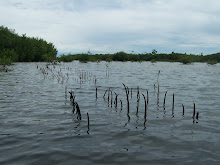
Here's a picture of a black mangrove forest that is going to be put into a private reserve this year. One of my projects will be working to set aside as much mangrove forest as possible this year. The little projections up from the soil provide oxygen to the roots of the black mangrove in marshy, anaerobic soil.

Thursday, June 18, 2009
Some cool U of I people
This trip to Belize is winding down until September.
Before I leave, I want to take stock and introduce you to a couple of people working on this project who have U of I roots.

This is John Cheeseman, professor of Plant Biology at the University of Illinois. Here he is checking out a red mangrove that was planted in a farm effluent outlet last November. John visited last week and gave a rousing lecture at a mangrove conservation workshop that I hosted in Placencia. I can still hear the cheering....
Some one once asked how do mangroves absorb nutrients from effluent water when they're planted on the banks of the canal. That's a good question. Here's the answer. Check out those roots! That's pretty impressive root development for a 7 month old plant, eh?

This is Linda Thornton, one of my favorite people in the world. Linda manages Aqua Mar Shrimp Farm and is the owner of Cardelli Shrimp Farm. Linda as lived and worked in the shrimp aquaculture industry in Belize for decades. If you want to know anything at all about shrimp, ask Linda. She knows. She's also one of the toughest, and most accomplished people I know...AND...she has been a stalwart supporter of efforts to improve the environmental sustainability of shrimp farming...AND...she is a proud graduate of the Department of Animal Sciences at the University of Illinois.
Go Illini!
Before I leave, I want to take stock and introduce you to a couple of people working on this project who have U of I roots.

This is John Cheeseman, professor of Plant Biology at the University of Illinois. Here he is checking out a red mangrove that was planted in a farm effluent outlet last November. John visited last week and gave a rousing lecture at a mangrove conservation workshop that I hosted in Placencia. I can still hear the cheering....
Some one once asked how do mangroves absorb nutrients from effluent water when they're planted on the banks of the canal. That's a good question. Here's the answer. Check out those roots! That's pretty impressive root development for a 7 month old plant, eh?

This is Linda Thornton, one of my favorite people in the world. Linda manages Aqua Mar Shrimp Farm and is the owner of Cardelli Shrimp Farm. Linda as lived and worked in the shrimp aquaculture industry in Belize for decades. If you want to know anything at all about shrimp, ask Linda. She knows. She's also one of the toughest, and most accomplished people I know...AND...she has been a stalwart supporter of efforts to improve the environmental sustainability of shrimp farming...AND...she is a proud graduate of the Department of Animal Sciences at the University of Illinois.
Go Illini!
Tuesday, June 9, 2009
Working the ponds
 The excavator has been hard at work at Aqua Mar shrimp farm removing old sediment from the sedimentation pond.
At Royal Maya shrimp farm, we have been regularly cleaning and recalibrating the In Situ probe and collecting the data for further analysis.
We've had a few bumps and we're a bit behind schedule, but we're getting good baseline data and things are moving ahead.
As the Uni High summer vacation moves ahead, keep thinking creatively about the project and checking back on the blog. If you find something interesting, go ahead and post it. We'll be ready to dive back in when school starts in fall.
Friday, May 29, 2009
The probe arrives!
The WWF water quality probe finally cleared all the hurdles at customs and arrived in Placencia this week. Representatives from the Central American and Belizean offices of WWF arrived to install the In Situ Troll. They're pictured below with captain and community researcher Adrian Vernon, consultants from Adcon Corporation (the company handling the satellite uplink), In Situ (the water quality probe manufacturer) and Rachel Carrie, a graduate student working with Xac Che, a group doing watershed work in southern Belize.

Here we are all heading out to the installation site.
Here Jon Thomas of In Situ demonstrates how to calibrate the water quality probe as Kendrick Gordon of Belize Department of Environment (left) and Jose Vasquez of WWF (on the right) look on.

Arnold Lara of Adcon works on the satellite uplink as community researcher as WWF representative Mauricio Mejia looks on.

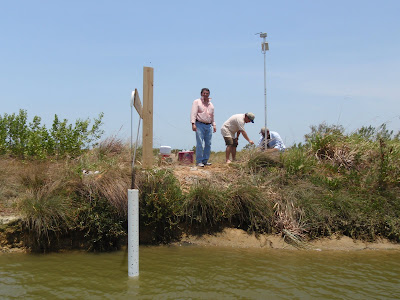

Here we are all heading out to the installation site.
Here Jon Thomas of In Situ demonstrates how to calibrate the water quality probe as Kendrick Gordon of Belize Department of Environment (left) and Jose Vasquez of WWF (on the right) look on.

Arnold Lara of Adcon works on the satellite uplink as community researcher as WWF representative Mauricio Mejia looks on.

And the finished system is ready to roll. We'll be watching the probe over the next few weeks and documenting the effects of efforts to improve water quality at the farms.

Progress!!
Subscribe to:
Posts (Atom)