Friday, September 25, 2009

Pending activities and welcome Wilbur!

It appears the next Inventor's Club meeting will be October 9 at 2:00PM (confirm with Mr. Bergandine). Club members will be brainstorming and going over designs.

In the meantime, work in Belize continues.


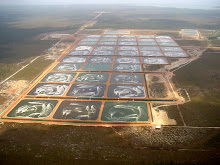
Wilbur Dubon, freshly graduated from Independence Jr. College (an adjunct institution to Independence High School), will kick off the intern program this year. A picture of the first meeting between Wilbur and Aquamar manager Linda Thornton is posted above. Wilbur will be engaged in field monitoring and water quality analysis in canals and mangrove areas over the coming weeks.

We hope to have 3 more students working on projects by January.

Welcome, Wilbur!

Wednesday, September 23, 2009

Back in Belize

After enjoying some time in Illinois watching the start of the 2009 Cross Country Season (go Uni!), I'm back in Belize and ready to move ahead with projects here.

I'll be meeting with shrimp farmers soon and preparing to implement designs from the Inventor's Club.

Look for me back in Urbana from October 7-14th.

Is there any news on the Illinois end?


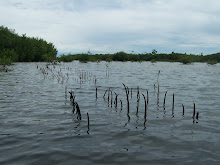
Here's a picture of a black mangrove forest that is going to be put into a private reserve this year. One of my projects will be working to set aside as much mangrove forest as possible this year. The little projections up from the soil provide oxygen to the roots of the black mangrove in marshy, anaerobic soil.

Thursday, June 18, 2009

Some cool U of I people

This trip to Belize is winding down until September.

Before I leave, I want to take stock and introduce you to a couple of people working on this project who have U of I roots.


This is John Cheeseman, professor of Plant Biology at the University of Illinois. Here he is checking out a red mangrove that was planted in a farm effluent outlet last November. John visited last week and gave a rousing lecture at a mangrove conservation workshop that I hosted in Placencia. I can still hear the cheering....

Some one once asked how do mangroves absorb nutrients from effluent water when they're planted on the banks of the canal. That's a good question. Here's the answer. Check out those roots! That's pretty impressive root development for a 7 month old plant, eh?


This is Linda Thornton, one of my favorite people in the world. Linda manages Aqua Mar Shrimp Farm and is the owner of Cardelli Shrimp Farm. Linda as lived and worked in the shrimp aquaculture industry in Belize for decades. If you want to know anything at all about shrimp, ask Linda. She knows. She's also one of the toughest, and most accomplished people I know...AND...she has been a stalwart supporter of efforts to improve the environmental sustainability of shrimp farming...AND...she is a proud graduate of the Department of Animal Sciences at the University of Illinois.

Go Illini!

Tuesday, June 9, 2009

Working the ponds

The excavator has been hard at work at Aqua Mar shrimp farm removing old sediment from the sedimentation pond.

At Royal Maya shrimp farm, we have been regularly cleaning and recalibrating the In Situ probe and collecting the data for further analysis.

We've had a few bumps and we're a bit behind schedule, but we're getting good baseline data and things are moving ahead.

As the Uni High summer vacation moves ahead, keep thinking creatively about the project and checking back on the blog. If you find something interesting, go ahead and post it. We'll be ready to dive back in when school starts in fall.

Friday, May 29, 2009

The probe arrives!

The WWF water quality probe finally cleared all the hurdles at customs and arrived in Placencia this week. Representatives from the Central American and Belizean offices of WWF arrived to install the In Situ Troll. They're pictured below with captain and community researcher Adrian Vernon, consultants from Adcon Corporation (the company handling the satellite uplink), In Situ (the water quality probe manufacturer) and Rachel Carrie, a graduate student working with Xac Che, a group doing watershed work in southern Belize.


Here we are all heading out to the installation site.

Here Jon Thomas of In Situ demonstrates how to calibrate the water quality probe as Kendrick Gordon of Belize Department of Environment (left) and Jose Vasquez of WWF (on the right) look on.


Arnold Lara of Adcon works on the satellite uplink as community researcher as WWF representative Mauricio Mejia looks on.


And the finished system is ready to roll. We'll be watching the probe over the next few weeks and documenting the effects of efforts to improve water quality at the farms.


Progress!!

Wednesday, May 13, 2009

More Sedimentation Ponds for AquaMats

One of the tasks of my current project is to reduce nutrient inputs from shrimp ponds to the local environment. As we have discussed, one of the ways that is done is by constructing sedimentation ponds. These, intuitively enough, trap sediment and nutrients attached to sediments. Eventually these ponds fill and need rehabilitation.

Thanks to some help from AquaMar Shrimp Farm, we will be able to use Aquamats in a freshly re-dug pond.

Meet Adolpho.


Adolpho operates a dredge at the farm. He will be creating deep areas along the sides of this sedimentation pond where our AquaMats can be deployed.


Presently, the pond has filled in from years of use. The trees you see growing in it are white mangroves.

Here you can see the layers of sediment that have been trapped in the pond over the years of use.


Adolpho will not only be scraping out some of that sediment, he will also be creating small, separate catchment areas inside the sedimentation pond that we can use to test the efficacy of the Aquamats as nutrient traps.

Once the Inventor's club substrate and biofilm removal system is in place, they could be deployed in those catchment areas as well.

Many thanks to Adolpho, AquaMar farm manager Linda Thorton and owner Mike Dunker for all their support.

Wednesday, April 22, 2009

Quick notes and Aquamats

Three agenda items here:

1. Meeting tomorrow at 11:35 at Uni High. I assume we're meeting at the usual spot.

2. We just passed 2000 hits on the Inventor's Club page. Our site has now been viewed in most states in the US, plus Canada, Mexico, Belize, Guatemala, Honduras, Costa Rica, Brazil, China, Germany, the Philippines, Thailand, Ecuador, Vietnam, Laos, Spain, India, Brunei, Malaysia, Singapore, the Cayman Islands, South Africa, Taiwan, Czechoslovakia, Turkey, Sweden, Finland and Iran. That's 28 countries so far.

Update, May 14th. 2122 hits and add Norway, Chile, Jamaica and Australia.

3. Newly acquired manufacturer information about AquaMats!

The following are facts gleaned from the Meridian Applied Technology Systems AquaMat Customer Information Manual (Nursery edition). We've already discussed much of this, but a summary may be useful here as we continue to think about our own substrates and scrapers.

AquaMats are especially recommended for nursery culture of shrimp from post larval stage 10 and up (approimately .01 to 2 grams of size). Sizes range from 2m X 1.22M to 2M X .61M. The Meridian Corporation reports up to 30% reductions in feed costs when AquaMats are used (a figure we may find useful for future calculations).

AquaMats require exposure to direct sunlight (as we have discussed).

AquaMats float. Therefore Meridian recommends that AquaMats be deployed on 2" PVC pipe frames sunk to the bottom and filled with sand. These are attached by cinching down by cable ties (those thin plastic strips used to bundle video cables).

Meridian also recommends that AquaMats be preconditioned prior to deployment. The desired colonizing organism (as we have discussed) is benthic diatoms. Diatoms are high in highly unsaturate fatty acids (HUFAs), an important nutritional item. Meridian discusses techniques that can be used to encourage the growth of specific desireable species. This is achieved by using pure cultures of these organisms and by saturating the mats in a solution of nitrate and phosphate salts (no lack of those in our sedimentation ponds) plus sodium metasilicate (silica is a limiting nutrient for diatoms) and some trace metals and vitamins.

Meridian recommends a 3 day culture time prior to introducing AquaMats as shrimp feed. This time period may vary with local conditions. As we discussed, if the mats are left in culture too long, they will acquire undesirable organisms. Each AquaMat user must determine the proper pre-conditioning time for their requirements.

Depending on the rates of algae growth and the density and growth rates of shrimp, algae films on AquaMats might continue to grow, become depleted or reach a steady-state where growth and removal become balanced.

Meridian states that AquaMats can be cleaned with a pressure hose and dried or simply returned to pre-condition tanks (effluent canals). Sterilization is generally not used, but can be used. The following sterilization methods are approved:

1. Steam sterilization @ 15 psi for 20 minutes.
2. 3% chlorate for 2 hours.
3. 10% Hydrochloric acid for 2 hours at 25 C
4. 30-50 ppm formalin for 1 hour
5. 3% acetoperoxide for 1 hour
6. Heating below 190 C

AquaMats are not recommended in systems with excessive fine clays. Secchi depths greater than 25 cm are required.

BARNACLES are a problem. Meridian recommends filtration of waters using Aquamats at 120 to 150 microns. We will have to address barnacle colonization (perhaps by scraping?).