We had a good meeting yesterday at Uni High.
Most of the discussion centered around cost-benefit analysis.
We set a few rules of thumb to help us think about the level of performance our nutrient recovery system should meet.
Operational Cost-Benefits
Benefits
Shrimp feed costs about 1$ US per kg. Thus every kg of feed we replace with periphyton (assuming growth and mortality in the pond systems feed periphyton remains the same) saves 1$ in feed.
Cost
Labor costs vary greatly and it's not possible to set one value for labor costs. For our purposes, we'll set a labor cost of 20$/day/person operating the system That's very high for most countries with large shrimp farming industries.
So in gross terms, to make the system operate without losing money, the farms need to recover 20kg (44 pounds) of periphyton per day of labor invested in operating the system. That's a lot of "goo" so we'll need an efficient system to make this work. Fortunately, we only need to move the periphyton a short distance (100' or less in most cases) from the canals to the ponds. According to the Aquamat literature, the growth rates on the mats will sustain this kind of harvest if we can harvest enough of them efficiently.
Other profits may come with ecocertifications and other benefits. Other costs will be involved in acquiring, deploying and maintaining the system. In the short term, let's focus on these core operating expenses and worry about those others later.
We also discussed some of the advantages and disadvantages of deployment strategies. One question that emerged right away was:
Should we:
a. design a substrate to be moved from the canals to the shrimp ponds or
b. design a substrate that can be scraped or shaken or somehow harvested.
Option "a" might provide a simple means of operation, but will require a replacement system to keep harvesting nutrients. That doubles materials costs for the same rate of nutrient removal from the canals.
Option "b" will require either a technical solution for harvesting and transferring the periphyton, or extra labor to take the substrate to the shrimp pond, remove the periphyton in the pond and then returning the substrate to the canals.
We covered some other ideas as well, but this is enough for now. We'll be looking for posts on the 4 topics the group suggested and suggestions and comments on the issues posted here.
Saturday, February 14, 2009

Tuesday, February 3, 2009
What will grow on our substrates?
Everything will grow on our substrates!
The study of encrustations, biofilms, periphtyon, aufwucs and colonization is as complex and detailed as any in ecology.
We won't learn everything about this topic, but we can learn enough to be ready to deal with whatever we find on our aquamats, pvc poles, oyster strings or whatever other material we set out in the effluent canals.
Here's what a PVC pole looks like after just a few days in an effluent canal (this one was deployed in an estuary just downstream of the canals).
You can see the light brown glaze. That color indicates that the organisms growing here are probably mostly diatoms, a nutritious food that invertebrates love to eat.
The same sized pole after 3 months in the water looks something like this....

The study of encrustations, biofilms, periphtyon, aufwucs and colonization is as complex and detailed as any in ecology.
We won't learn everything about this topic, but we can learn enough to be ready to deal with whatever we find on our aquamats, pvc poles, oyster strings or whatever other material we set out in the effluent canals.
Here's what a PVC pole looks like after just a few days in an effluent canal (this one was deployed in an estuary just downstream of the canals).

You can see the light brown glaze. That color indicates that the organisms growing here are probably mostly diatoms, a nutritious food that invertebrates love to eat.
Within about 3-6 weeks, the biomass on that pole will reach a "steady state" to which little biomass can be added. The total biomass of organisms will remain about the same from that point forward.
The same sized pole after 3 months in the water looks something like this....

The diatoms and the other nutritious diet items are still on the pole, but they have been joined by a wide variety of other organisms. The heavy lumps are barnacles. The dark green color comes mostly from blue green algae. Neither of those are desireable as food (although they may have other uses). Also colonizing the pole was a variety of worms, crabs and fishes (very small gobies were living inside some of the dead barnacle). Eggs of some organisms might also be attached.
Here are some questions for our groups to consider.
- How can we minimize the amount of harmful or competing organisms entering the ponds from the substrates (some organisms like crabs and fish are already in the ponds because they enter the ponds as eggs from the pump, but we should still probably think about how to minimize the things we don't want).
- How do we move large volumes of material off the substrates cheaply and without releasing the colonizing material back into the effluent canals?
- How much time should these substrates sit before they are "harvested"?
- What kind of data would we need to make these decisions scientifically?
Based on some coarse calculations, it seems we should be able to acheive significant reductions in the amount of nitrogen exiting the effluent canals (although I do need to correct an earlier assertion, apparently there are 30,000 Aquamats available, not 100,000).
Here's a link to a source that will tell you quite a bit about algae growing on attached surfaces. It may be useful to us here.
Friday, January 30, 2009
More context
 Roseate spoonbills and wood storks forage in an effluent canal
 The following links are provided to help set the framework for understanding the social setting for aquaculture. There are important facts here that everyone should learn. Be warned, however, that these web sites all tell the truth from their own perspective. Some information is outdated. Some is biased. As you read, be good scientists. Think objectively. Be skeptical. Look for alternative hypotheses and weigh the information you're given with the best data and evidence you can find.
Hopefully these links and other information will give you a sense of the historical nature of the aquaculture industry. Here in Illinois, we live in a landscape transformed by agriculture, a process that began 10,000 years ago. In our lifetimes, the sea is being transformed in the same way. The traditional hunter-gatherer fisheries capturing wild animals for food is giving way to aquaculture.
The unique difference between cultivated foods on the land and the sea is that aquaculture is occurring in a context where science, vastly superior technology, and an awareness of the need conserve and protect natural resources can guide its’ development from the outset. Just as terrestrial agriculture transformed humans and made civilization possible, aquaculture creates resources that have significant potential to alter not only human history, but the natural history of the planet.
Welcome to your part in an historical process.
Aquaculture organizations and news sources
https://www.was.org/Main/Default.asp
http://www.gaalliance.org/
http://www.shrimpnews.com/
Belizean shrimp aquaculture links
http://www.worldwildlife.org/what/globalmarkets/agriculture/ridgetoreef.html
http://www.worldwildlife.org/what/globalmarkets/aquaculture/grandma.html
http://www.balshrimp.com/
http://www.fao.org/fishery/countrysector/naso_belize
Belizean history, culture, language, newspapers and environment
http://www.kriol.org.bz/index.htm
http://www.amandala.com.bz/
http://healthyreefs.org/
http://www.worldwildlife.org/what/wherewework/mesoamericanreef/
2006 Slate article regarding shrimp aquaculture
http://www.slate.com/id/2134219/
Shrimp aquaculture ecocertification dialogues
http://www.worldwildlife.org/what/globalmarkets/aquaculture/WWFBinaryitem8614.pdf
http://www.worldwildlife.org/what/globalmarkets/aquaculture/dialogues-shrimp.html
Environmental critics of shrimp farming
http://www.worldwatch.org/node/1500
http://www.mindfully.org/Water/2004/Aquaculture-Blue-RevolutionJan04.htm
http://www.mangroveactionproject.org/
Friday, January 23, 2009
Basic info. and (shrimp) food for thought
I had some conversations with contacts in Belize yesterday. It appears we'll be hearing from Independence High School within a couple of weeks.
In the meantime, I'm going to begin posting a few bits of basic information and web links that we can use to help us begin thinking about the project.
Again, the basic goal of the project is to design a substrate that can be deployed in shrimp pond waste effluent canals, colonized by aquatic organisms (especially algae and bacteria) and stripped to feed shrimp. This process uses waste effluent nutrients to create a healthy, cost-effective economic resource. To be sustainble and useful, the whole process needs to have minimal materials and labor costs and needs to provide the maximum possible amount of healthy food for cultured shrimp and the maxiumum possible nutrient removal from effluents.
We will eventually need to make decisions about what substrates to use, how to deploy them, how often to deploy them, how to retrieve them,
One substrate we can use is the Aquamat. Here is a web page that has pictures of Aquamats and discusses how they work.
http://www.nurturetech.net/aqua.htm
Notice in the text that Aquamats fix (grow) between 1.3 to 0.5 g/m of nitrogen every day Phosphorus uptake will be between 25-30 mg/m/day. Most of that growth will be in the form of algae and bacteria that are desirable food items for shrimp.
For a conservative rule of thumb, let's assume we can grow about 1 gram of N per day and 0.05 g/P per day on each Aquamat.
That is enough N and P to improve water quality around the farms if..
1. Enough Aquamats are in place
2. The organisms growing on them can actually be effectively removed from the effluent canals and sedimentation ponds.
That material will be useful as feed for the farmers if….
1. The labor cost of stripping food organisms from the mats is less than the cost of feed and feeding
2. The “food” organisms promote healthy growth of the shrimp equal to or greater than the cost of similar production.
If we can devise an effective system that meets these goals we can improve both the environmental and economic sustainability of shrimp farming in Belize.
Saturday, January 17, 2009
Good meeting yesterday
The Inventor's Club had a productive meeting yesterday at Uni High. We walked back through the project and talked about some of the things we hope to accomplish. Mr. Bergandine suggested that we continue to meet on Fridays during February, so we'll probably have several more meetings soon.
If you're just coming to the site, I encourage you to read the previous posts and post questions and comments. I monitor the site frequently and you'll get an answer to your question within a day or so.
In the meantime, I'll be working to get our partners ready to go and provide technical information to help us all start thinking about what kind of materials and substrates we should be thinking about as a periphtyon substrate in Belizean shrimp pond effluents.
Watch the web site too for posts from visitors. Several people have expressed an interest in our project and it will be great for us to hear their perspectives on what we are planning to do.
If you're just coming to the site, I encourage you to read the previous posts and post questions and comments. I monitor the site frequently and you'll get an answer to your question within a day or so.
In the meantime, I'll be working to get our partners ready to go and provide technical information to help us all start thinking about what kind of materials and substrates we should be thinking about as a periphtyon substrate in Belizean shrimp pond effluents.
Watch the web site too for posts from visitors. Several people have expressed an interest in our project and it will be great for us to hear their perspectives on what we are planning to do.
Monday, January 5, 2009
This is a satellite photo of a typical shrimp pond drainage system.
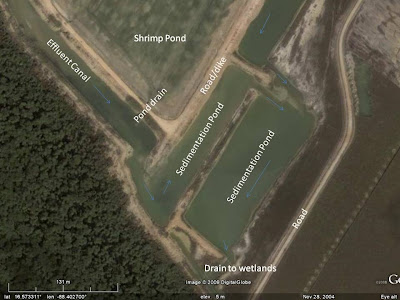
Water carrying high levels of nutrient from the shrimp pond (upper middle) is released through a drainage structure into an effluent canal. The effluent canal carries the water to sedimentation ponds where some of the nutrient settles out to the bottom of the pond, enters the food chain or is released into the atmosphere through de-nitrification. During the final step of treatment, the water flows from the sedimentation pond into a natural wetland mostly full of red mangrove. After that, it then enters a tidal creek and then flows to the sea where it eventually dilutes to become equivalent to background levels. The size of these canals varies. They are usually longer than a kilomter from 2 to 50 meters wide with a depth from 1.8 meters to less than one meter in depth.
The overall short-term goal is to reduce the amount of nutrient (primarily nitrogen and phosphorus in all forms) exiting the sedimentation pond and entering the natural wetland.
The Inventors Club project will be to design a substrate that can be placed in these effluent canals, colonized by algae, biofilms and biofouling organisms, and then stripped to feed the shrimp growing in the ponds nearby.

Water carrying high levels of nutrient from the shrimp pond (upper middle) is released through a drainage structure into an effluent canal. The effluent canal carries the water to sedimentation ponds where some of the nutrient settles out to the bottom of the pond, enters the food chain or is released into the atmosphere through de-nitrification. During the final step of treatment, the water flows from the sedimentation pond into a natural wetland mostly full of red mangrove. After that, it then enters a tidal creek and then flows to the sea where it eventually dilutes to become equivalent to background levels. The size of these canals varies. They are usually longer than a kilomter from 2 to 50 meters wide with a depth from 1.8 meters to less than one meter in depth.
The overall short-term goal is to reduce the amount of nutrient (primarily nitrogen and phosphorus in all forms) exiting the sedimentation pond and entering the natural wetland.
The Inventors Club project will be to design a substrate that can be placed in these effluent canals, colonized by algae, biofilms and biofouling organisms, and then stripped to feed the shrimp growing in the ponds nearby.
Saturday, December 27, 2008
Preparing for the project
Stay tuned for when we set the January meeting to begin to line up a more precise plan of action. In the meantime, you might be intersted to know that this little web site has begun to attract a little attention.
Without trying to attact any traffic at all, we've have hits from 11 states and 9 countries including the US, Canada, Mexico, Belize, Guatemala, Honduras, Brazil, China and Germany.
People are interested in the project.
January 15th, 2009: We have still not sought any publicity but our web site has now accumulated over 400 hits and in addition to the countries posted above, we have also been visited from the Philippenes, Thailand, Ecuador, Vietnam, Laos, Costa Rica, Spain, India and Brunei. Articles about our project have also been published in the newsletter of The Mangrove Action Project and Shrimp News.
February 15th, 2009: Add Malaysia, Singapore and the Cayman Islands. Nearing 1000 hits.
February 28th, 2009: Add South Africa, Taiwain, Czechosolvakia, Turkey and Sweden.
April 6th, 2009: Add Croatia, Saudia Arabia, Netherlands, Dubai.
http://www.mangroveactionproject.org/news/current_headlines/protecting-the-mesoamerican-reef-nutrient-abatement-for-shrimp-farm-waste-effluent/
http://www.shrimpnews.com/FreeNews.html
Without trying to attact any traffic at all, we've have hits from 11 states and 9 countries including the US, Canada, Mexico, Belize, Guatemala, Honduras, Brazil, China and Germany.
People are interested in the project.
January 15th, 2009: We have still not sought any publicity but our web site has now accumulated over 400 hits and in addition to the countries posted above, we have also been visited from the Philippenes, Thailand, Ecuador, Vietnam, Laos, Costa Rica, Spain, India and Brunei. Articles about our project have also been published in the newsletter of The Mangrove Action Project and Shrimp News.
February 15th, 2009: Add Malaysia, Singapore and the Cayman Islands. Nearing 1000 hits.
February 28th, 2009: Add South Africa, Taiwain, Czechosolvakia, Turkey and Sweden.
April 6th, 2009: Add Croatia, Saudia Arabia, Netherlands, Dubai.
http://www.mangroveactionproject.org/news/current_headlines/protecting-the-mesoamerican-reef-nutrient-abatement-for-shrimp-farm-waste-effluent/
http://www.shrimpnews.com/FreeNews.html
Subscribe to:
Posts (Atom)