It's great to see the first bit of information from the substrate tests. The early phases of the project seem to be going fine.
The Lemelson-MIT grant and the UN SEED grants have been submitted and we'll find out about those soon. The farms are excited and ready to go. On Tuesday this week, I visited one of our farms with a WWF representative. We happened to bump into the pond manager there and he was excited about the project and volunteered his time on weekends to help the IHS students with the field work. I also found out that the probe WWF is installing has finally cleared customs in Honduras and will be arriving in about 2 weeks.
A couple of other things have slowed us down a bit. It will be Easter holday in Belize until Monday next week, so we lost a bit of class time at IHS. Also, I was burglarized and my computer, field notes, back-ups and underwater camera were stolen (life lesson learned: NEVER keep your computer and backups together, even if you're just carrying them in in a back pack for a bit).
So I'm taking 2 weeks in the US to do some family things and trying to recover lost data. I could make a meeting next Friday with the Uni Inventor's Club if you plan to meet.
Look for a post from me soon with information from the Aquamat manufacturer.
Friday, April 17, 2009

Sunday, April 5, 2009
Experiment Update- D+3 weeks, Also Group B Minutes
 Vinyl progress: not as much growth as the screens, but stays lightweight and the smooth surface makes it easy to remove material.
Fiberglass screen is a close second to the steel in amount of growth.
 Rubber comes dead last in terms of growth. Material (dirt?) comes off just by touching. But its close neighbor, the steel screen, wins the prize.
Note the abscence of the weed mat. It was growing little more than the rubber, and then was removed from the PVC by the lake. I didn't rescue it.
Lessons learned from this experiment so far:
-This rubber will not work.
-A fiberglass or steel screen may encourage more growth, but they complicate removal quite a bit, since the material can't just 'slide' off.
-Vinyl is most compatible with our current removal plan (see below) but it hasn't accumulated a whole lot of biomass.
In the near future I plan to take sample material under a microscope to see what exactly we "caught".
Another order of business:
The biomass-removal group met to explore our ideas.
We briefly researched algae removal techniques and found little of use. The nets came up with a variety of lake and aquarium algae removal devices, ranging from vacuums to string algae brushes. The closest device we found to our dreamed-up device was a flexible stainless steel scraper shaped like a rake, designed for scraping algae from large glass aquarium sides.
In our meeting, EFritzch proposed his idea for the device and we critiqued/improved it. I'll have him post about this, but it basically allows for one-sweep scraping without repeatedly having to pull the scraper in and out of the boat.
And lastly, welcome IHS students! We're so glad to be able to collaborate with you on this project.
Friday, April 3, 2009
Next Meeting
Met at IHS again yesterday. We had problems with internet connections, but a few students are still getting hooked up with the blog through their own resources. We're meeting next week in an internet cafe to help other students get started.
Right now the local students are just getting grounded in the project. It appears we'll be able to make trips through May to the farms so hopefully we can post some results by the end of the school year. Fall semester will probably be the bigger push, but we're getting in good ground work now, especially these preliminary experiments with substrates.
Let us know how the substrate experiments are going and take some time to meet the new bloggers from IHS. I'll post new information on Aquamats and a couple of recent experiences from the lagoon.
Right now the local students are just getting grounded in the project. It appears we'll be able to make trips through May to the farms so hopefully we can post some results by the end of the school year. Fall semester will probably be the bigger push, but we're getting in good ground work now, especially these preliminary experiments with substrates.
Let us know how the substrate experiments are going and take some time to meet the new bloggers from IHS. I'll post new information on Aquamats and a couple of recent experiences from the lagoon.
Friday, March 20, 2009
Club Minutes 3/20
1. Lemelson-MIT grant. We looked over and edited a draft of the project summary for our initial submission to the grant; that will be sent in (or has been sent) today.
2. Group meetings. Material removal will meet at my place on Monday to discuss design ideas we've developed and to check on the experiment so that we'll have a more tangible idea of what we're working with. Structure group- keep on researching, communicate through the blog.
3. Anchor report. Adam has been gathering contacts and working on the problem of how to keep the structure we create in place. We decided to depart from the idea of setting pipes at the bottom of the lake for structural support because of unwanted expense, difficulty of installation, and the fact that our current design doesn't involve a lot of structure at the bottom. We'll now look into attaching from the top, researching the type of rope, knot, and stakes we can use to keep our structure in place.
4. Tej said his dad is working on a pricing algorithm. Post with explanation?
2. Group meetings. Material removal will meet at my place on Monday to discuss design ideas we've developed and to check on the experiment so that we'll have a more tangible idea of what we're working with. Structure group- keep on researching, communicate through the blog.
3. Anchor report. Adam has been gathering contacts and working on the problem of how to keep the structure we create in place. We decided to depart from the idea of setting pipes at the bottom of the lake for structural support because of unwanted expense, difficulty of installation, and the fact that our current design doesn't involve a lot of structure at the bottom. We'll now look into attaching from the top, researching the type of rope, knot, and stakes we can use to keep our structure in place.
4. Tej said his dad is working on a pricing algorithm. Post with explanation?
Thursday, March 19, 2009
Meeting in Independence

The meeting in Independence went quite well yesterday. Over 60 students from 1-4 forms (Middle School through High School age) attended. The level of interest was high. We'll have a follow-up meeting in about 10 days to set up Google accounts and begin posting. I noticed a big uptick in the web site hits from Belize, so some students are obviously already checking out the site.
In addition to the meeting at Independence, I also was able to meet with local shrimp farmers and get their input on the project. The reception among the shrimp farmers to our project has been very positive here.
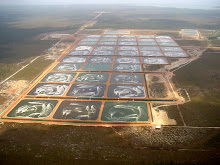
 One of those farms is allowing us to use their AquaMats for the substrate experiments this spring. For anyone who is wondering, here is a shot of the AquMats we'll be using to test the substrate mitigations this spring. As you can see, there's no lack of material here. Your experiments are starting on a small scale (as is appropriate), but when they are fully developed you'll be dealing with quantities of material like this.
 One of those farms is allowing us to use their AquaMats for the substrate experiments this spring. For anyone who is wondering, here is a shot of the AquMats we'll be using to test the substrate mitigations this spring. As you can see, there's no lack of material here. Your experiments are starting on a small scale (as is appropriate), but when they are fully developed you'll be dealing with quantities of material like this.
Saturday, March 14, 2009
D-Day: The Experiment Begins
Today at 7:00 pm I threw these PVCs loaded with potential substrate into the catchment pond. The aluminum, fiberglass, and rubber squares are attached with picture wire. The vinyl and weed guard mat (which I attached at the last minute purely because it was sitting in my garage) are attached with duct tape since the wire cut too easily through those materials. The PVC pipes are held to the bank by fishing line and stakes. 


Friday, March 13, 2009
Hardware Store
Club members ecrussel and e.allen paid a visit to Lowe's this evening, scouting any possible materials that could be used in place of aquamats in the designs below.
The initial plan is to attach all of these potential substrates to PVC with duct tape and submerge in a nasty pond to get a feel for the timeline, what works, and what doesn't. Daily (twice daily?) checks will be performed and I will record visible changes.
The material was chosen based on information from Lowe's personnel Jenny and Tim (we briefed them on our project and threw around material names).
We have:
91x213 cm fiberglass screening
91x213 cm aluminum screening
Dur-a-bull Indoor-outdoor mat 91x122 cm
Style selections premium vinyl shower curtain liner 183x183 cm
Rubber mat approx 15x15 cm
2 2.54cm x 1.52400m PVC and 4 caps to fit on the ends.
We will cut all materials into .5x.5m squares except for the small rubber mat, which was the only material of its kind available at Lowe's.
The screens will go into the water tomorrow at 6:00 pm, and will be checked at 6 am every day.
This is only the rough start of a series of experiments, and we will get more precise measurements in the future. Please comment with any modifications you would like to offer on this experiment, or any ideas for future experiments, or any other type of feedback.
Thanks for frequently checking into the blog!
-ecrussel and e.allen
The initial plan is to attach all of these potential substrates to PVC with duct tape and submerge in a nasty pond to get a feel for the timeline, what works, and what doesn't. Daily (twice daily?) checks will be performed and I will record visible changes.
The material was chosen based on information from Lowe's personnel Jenny and Tim (we briefed them on our project and threw around material names).
We have:
91x213 cm fiberglass screening
91x213 cm aluminum screening
Dur-a-bull Indoor-outdoor mat 91x122 cm
Style selections premium vinyl shower curtain liner 183x183 cm
Rubber mat approx 15x15 cm
2 2.54cm x 1.52400m PVC and 4 caps to fit on the ends.
We will cut all materials into .5x.5m squares except for the small rubber mat, which was the only material of its kind available at Lowe's.
The screens will go into the water tomorrow at 6:00 pm, and will be checked at 6 am every day.
This is only the rough start of a series of experiments, and we will get more precise measurements in the future. Please comment with any modifications you would like to offer on this experiment, or any ideas for future experiments, or any other type of feedback.
Thanks for frequently checking into the blog!
-ecrussel and e.allen
Subscribe to:
Posts (Atom)